
Offshore wind parks in the Baltic Sea
Lithuania's offshore wind parks are among the most important Lithuanian energy independence projects. These projects will significantly increase the production of electricity from renewable energy sources, thus reducing Lithuania's dependence on electricity imports and ensuring low electricity prices for residents.
The offshore wind parks, which will begin to operate by 2035 in the part of the exclusive economic zone of the Republic of Lithuania in the Baltic Sea near Palanga with a capacity of approximately 1,4 GW, are expected to generate up to 6 TWh of green electricity per year, which would meet up to a half of Lithuania’s current electricity demand. The offshore wind parks are also expected to attract around EUR 3 billion in investments and create at least 1,300 new jobs.
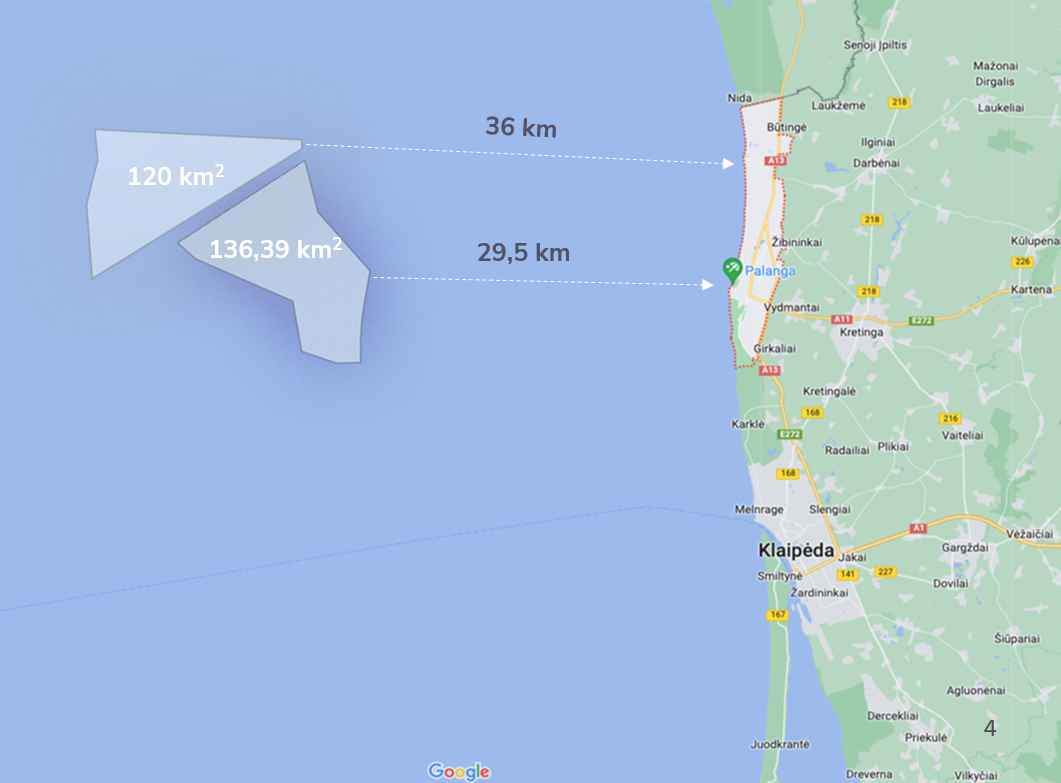
The first tender for a 700 MW offshore wind farm was announced on March 30, 2023. The winners were legal entities operating under a joint venture agreement: UAB Ignitis renewables and OW OFFSHORE, S.L., which offered the state the highest development fee of EUR 20 million. The winners of the tender have acquired the right to develop an offshore wind farm covering an area of 120 km2 in the Baltic Sea, approximately 36 km from the coast. The project has been named Curonian Nord. More detailed information about the progress of the project is available on the developer's website: Lithuanian offshore wind farm | Curonian Nord
A tender for the developer of the second 700 MW offshore wind farm is planned to be announced on June 9, 2025. The area designated for the development of offshore wind farms covers approximately 136,39 km2, and the farm will be located approximately 36 km from the coast. The second tender is being organized with the possibility of receiving state aid, which could be paid for 15 years from the date of obtaining the generation permit.
In accordance with the laws of the Republic of Lithuania and taking into account European practice in the development of offshore wind farm, the necessary procedures and studies must be carried out for this strategically important energy project for the Republic of Lithuania, including:
VALUE CREATED BY AN OFFSHORE WIND PARKS
- The offshore wind power plants projects will enable implementation of the main objective of the National Energy Independence Strategy in the field of renewable energy sources: further increasing the share of renewable energy sources in Lithuania's domestic energy production and final energy consumption balance, thereby reducing dependence on fossil fuel imports and increasing domestic electricity production capacity;
- The offshore wind parks will ensure lower electricity prices for Lithuanian residents and businesses;
- Wind energy sources are renewable, which means they are inexhaustible;
- Wind energy does not pollute the air and makes it possible to reduce climate impact.
Benefits for the coastal community
- It is planned that the budget of nearest city municipality will be annually supplemented by about EUR 3 million, which the parks developer will be obliged to pay from the amount of electricity generated and supplied to the network;
- The winner tenderers will have to allocate at least EUR 5 million for the purposes of environmental protection in the maritime territory of Lithuania;
- During the construction and exploitation period, it is planned to create as many as 1.3 thousand new jobs;
- Not less than 3 percent the construction works of the park will have to be carried out by small and medium-sized enterprises.
Place of the projects





Connection of offshore wind farms
The connection of offshore wind farms is planned on land, at the Darbėnai substation.
The specific routes of the engineering infrastructure corridors will be planned in the decisions of the draft “Development plan for the engineering infrastructure of territories required for connecting power plants using renewable energy sources, planned to be developed in the marine area (areas) adjacent to electricity transmission networks” (hereinafter referred to as the engineering infrastructure development plan).
The engineering infrastructure development plan is in its final stages. During the preparation of the concept, different alternatives for connecting the two offshore wind farms were examined, a strategic environmental impact assessment was carried out, and cross-border consultations and discussions were organized with state institutions responsible for environmental protection and the public.
The selected engineering infrastructure corridor routes have been assessed as the most favorable from an environmental perspective. Their implementation will ensure that coastal dunes will not be destroyed and that wintering birds and underwater habitats will not be affected. All infrastructure planned on land will be built underground to ensure minimal impact on people's property and planned economic activities.
